


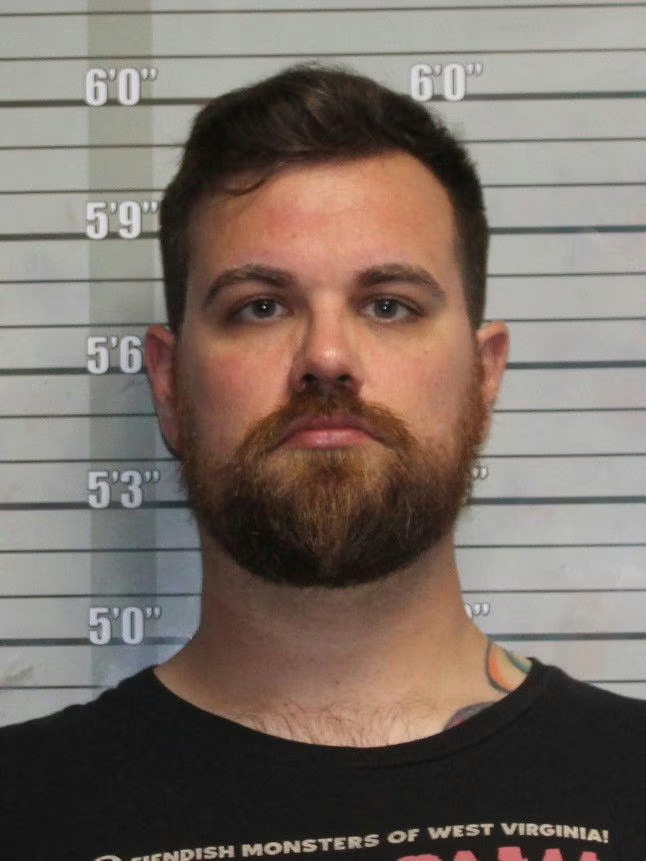
John Carter was the fiancé of Katelyn Markham, the 21-year-old Ohio art student who disappeared from her Fairfield home in August 2011 and whose skeletal remains were found in Indiana in April 2013. Carter was one of the central figures in the investigation from its first hours because he reported Katelyn missing and said he was among the last people known to have seen her.
For more than a decade, Carter denied involvement in Katelyn’s disappearance and death. Investigators continued examining his statements, movements and relationship with Katelyn as the case moved from a missing-person investigation to an unsolved homicide. In March 2023, a Butler County grand jury indicted him on two counts of murder. He later avoided a murder trial by pleading guilty to involuntary manslaughter in 2024.
Carter received the maximum three-year prison sentence. He later sought early release, but a judge rejected that request in January 2026 and ordered him to complete his sentence. The latest reporting in 2026 places Carter at North Central Correctional Institution in Marion, Ohio.
- “The Butterfly”: Dateline NBC Revisits the Homicide of Katelyn Markham August 22 2026
- Who Was Katelyn Markham & What Happened to Her? 2026 Update & Profile
Contents
- Carter and Katelyn Markham’s Relationship
- Carter’s Account of Katelyn’s Final Night
- Carter Participates in the Search for Katelyn
- Scratches on Carter’s Neck Draw Attention
- Investigators Question Carter’s Timeline
- Katelyn’s Remains Are Found
- Why Carter Was Not Charged for More Than a Decade
- Investigators Reexamine Carter
- Writings Found at Carter’s Mother’s Home Become Evidence
- John Carter Is Arrested for Murder
- Prosecutors Build a Circumstantial Murder Case
- Carter Pleads Guilty to Involuntary Manslaughter
- Carter Is Sentenced to the Maximum Three Years
- Carter Continues to Dispute That He Caused Katelyn’s Death
- Carter Asks to Leave Prison Early
- Prosecutor Challenges Carter to Tell the Full Story
- Prosecutors Raise the Possibility That Carter Protected Someone
- John Carter Is Denied Early Release
- Where Is John Carter Now?
- Why Carter Received Only Three Years
- Carter’s Conviction Did Not Solve Every Part of the Case
- Where the John Carter Case Stands in 2026
- More “The Butterfly”
- More Feature Articles
Carter and Katelyn Markham’s Relationship
Carter and Katelyn had been together for several years before her disappearance. By the summer of 2011, they were engaged. Carter had proposed about a year earlier, and Katelyn was approaching the end of her studies in graphic design.
The couple did not live together. Katelyn lived in a Fairfield townhouse, while Carter was living at his mother’s home. Carter worked as a pizza delivery driver, and their schedules sometimes differed.
When Katelyn first disappeared, Carter presented himself as a worried fiancé searching for the woman he planned to marry. During a community search in August 2011, he told reporters that he believed Katelyn was still alive and wanted her returned home.
Years later, investigators developed a different view of the relationship. A witness interviewed during the renewed investigation reportedly described an argument between Katelyn and Carter shortly before she disappeared and believed their relationship was experiencing problems. That information became part of the broader circumstantial case developed against Carter.
Carter’s Account of Katelyn’s Final Night
Carter told investigators that he spent part of August 13, 2011, with Katelyn and mutual friend Brad von Bargen. According to the account later examined by investigators, Carter left Katelyn’s home and spent time with friends before returning to his mother’s residence.
Katelyn’s cellphone activity ended around midnight. Carter said he returned home around 1:30 a.m., watched television programs on his computer and later sent Katelyn a message.
When Katelyn did not respond the following day, Carter said he became worried. He went to her townhouse and found her vehicle still there.
Carter called 911 and reported his fiancée missing.
Inside the home, Katelyn’s wallet, identification and money remained behind. Her dog had also been left inside. Her cellphone was missing.
Carter Participates in the Search for Katelyn
During the first days of the investigation, Carter joined Katelyn’s relatives, friends and community members in searching for her.
On August 16, 2011, he spoke publicly about his hope that she would be found alive. He said he had last seen Katelyn on Saturday night and had become concerned when she stopped responding to messages.
At that point, police had not announced evidence establishing that Katelyn had been the victim of a crime. She remained classified as a missing person.
Behind the scenes, however, detectives had begun scrutinizing Carter.
Scratches on Carter’s Neck Draw Attention
One of the details investigators noticed during their early contact with Carter was a series of red marks or scratches around his neck.
Investigators questioned how Carter received them. Carter offered explanations that included shaving, but authorities considered the location of the marks unusual.
The scratches became one piece of the circumstantial evidence discussed during the later investigation.
They did not prove that Carter had been involved in a physical confrontation with Katelyn. No forensic evidence publicly established that Katelyn caused the marks, and the issue was never decided by a jury because Carter’s murder case ended with a plea agreement.
Investigators Question Carter’s Timeline
Carter’s account of his movements during the early morning hours also received scrutiny.
He maintained that he returned to his mother’s home around 1:30 a.m. and watched television programs on his computer. Investigators confirmed that programs had played on the computer.
However, investigators later found that Carter searched for plot summaries of programs he claimed to have watched.
Two witnesses also came forward during the renewed investigation and said that, as teenagers, they had seen Carter leave his home and travel toward Katelyn’s residence during the night she disappeared. Carter rejected their account. In a recorded interview released after his conviction, Carter called the witnesses liars.
Investigators told Carter during a later interview that his story had changed over the years. Carter responded that approximately 12 years had passed and acknowledged that parts of his accounts might differ.
Katelyn’s Remains Are Found
For almost two years, Carter remained connected to the case as the fiancé of a missing woman rather than as a person charged with a crime.
That changed in terms of the nature of the investigation after April 7, 2013.
A couple searching for scrap material discovered human remains near Big Cedar Creek in Cedar Grove, Indiana. Dental records established that the remains belonged to Katelyn.
Her death was ruled a homicide, although authorities could not determine the cause of death.
Forensic examination found evidence of trauma. Prosecutors later disclosed that Katelyn’s left wrist bone contained several injuries described as sharp and blunt-force trauma. Investigators also concluded that her remains had not remained in the location where they were discovered.
Carter continued denying responsibility.
Why Carter Was Not Charged for More Than a Decade
Although investigators had suspicions concerning Carter, suspicion was not enough to prosecute him for murder.
The case presented substantial problems. There was no known eyewitness to Katelyn’s killing, no publicly identified murder weapon and no established cause of death.
Investigators could establish that Katelyn had been killed, but reconstructing precisely how she died was another matter.
Years passed without an arrest.
The Butler County Prosecutor’s Office later revived the cold case and began reviewing the evidence, previous interviews, witness statements, computer information and other records.
Investigators Reexamine Carter
The renewed investigation focused on inconsistencies authorities believed existed in Carter’s accounts.
Investigators interviewed Carter again and confronted him about witnesses, his timeline and other evidence.
Recordings released after the criminal case ended show investigators telling Carter that his story had changed during the years since Katelyn disappeared. Carter continued disputing their conclusions and questioned what evidence they had against him.
Investigators also questioned Carter’s friend Johnathan Palmerton about whether he had assisted Carter or concealed information. Palmerton denied participating in anything connected with Katelyn’s death. No charge against Palmerton in connection with Katelyn’s killing resulted from those interviews.
The possibility that someone assisted with moving or concealing Katelyn’s remains remained one of the unresolved elements of the investigation.
Writings Found at Carter’s Mother’s Home Become Evidence
Prosecutors also disclosed writings recovered from Carter’s mother’s home, where Carter had been living when Katelyn disappeared.
One typed poem or passage described an internal conflict involving loving a woman while contemplating her death.
Butler County Prosecutor Michael Gmoser argued that the writing demonstrated an internal conflict within Carter.
The document attracted attention because of its language, but it was not a direct confession to killing Katelyn. Its date and precise relevance were matters that could have been contested at trial.
Because Carter later entered a plea agreement, jurors never evaluated what significance, if any, the writing should have carried in determining whether he committed murder.
John Carter Is Arrested for Murder
The renewed investigation produced the development Katelyn’s family had waited more than a decade to see.
A Butler County grand jury secretly indicted Carter in March 2023.
He was arrested and informed that he had been charged with murder.
A recording of the encounter later released to the public captured Carter asking investigators what evidence they had against him. Detectives told him they had accumulated substantial circumstantial evidence and believed his accounts did not add up.
Carter faced two counts of murder. One accused him of purposely causing Katelyn’s death around August 13 or 14, 2011. The second alleged that Katelyn died as the result of Carter committing or attempting to commit felonious assault.
Carter pleaded not guilty and prepared for trial.
Prosecutors Build a Circumstantial Murder Case
The prosecution did not possess one piece of forensic evidence that proved its entire theory.
Instead, authorities sought to construct the case through the combination of Carter’s relationship with Katelyn, his statements, witness accounts, the scratches observed after her disappearance, computer activity and forensic findings concerning Katelyn’s remains.
That created risks for prosecutors.
Katelyn’s cause of death could not be established. The state would have needed to convince jurors beyond a reasonable doubt that Carter had committed murder despite being unable to tell them through medical evidence how Katelyn died.
The defense, meanwhile, intended to challenge the state’s evidence and maintain that Carter had not murdered Katelyn.
The question appeared headed for a jury until the case changed shortly before trial.
Carter Pleads Guilty to Involuntary Manslaughter
On June 7, 2024, Carter entered a guilty plea to involuntary manslaughter in connection with Katelyn’s death.
The plea represented a major reversal after years of denying responsibility.
In exchange, prosecutors dropped the murder counts, eliminating the possibility that Carter could be convicted of murder and receive a much longer sentence. His trial had been scheduled to begin later that month.
The agreement capped Carter’s potential prison sentence at three years.
It also prevented the murder evidence from being tested before a jury.
Carter did not provide the detailed public explanation of Katelyn’s final hours that her family wanted.
Carter Is Sentenced to the Maximum Three Years
On July 18, 2024, Butler County Common Pleas Court Judge Daniel Haughey sentenced Carter to three years in prison, the maximum available under the plea agreement.
He was transferred from the Butler County Jail into the Ohio prison system later that month. Carter was first processed at the Correctional Reception Center in Orient before receiving his prison assignment.
The sentence was far below what Carter could have faced following a murder conviction.
For Katelyn’s father, Dave Markham, the sentence provided accountability but remained difficult to reconcile with the loss of his daughter and the years the family spent without answers.
Carter Continues to Dispute That He Caused Katelyn’s Death
One unusual aspect of the case emerged after Carter’s guilty plea.
Although he had formally pleaded guilty to involuntary manslaughter, his defense later maintained that he continued to deny causing Katelyn’s death.
During Carter’s January 2026 judicial-release proceedings, defense attorney Carl Lewis argued that Carter accepted the plea because of the risks involved in proceeding to trial on murder charges. Lewis said Carter continued to maintain that he had not caused Katelyn’s death.
Judge Haughey rejected that position as a reason for release.
The judge emphasized that Carter had entered a guilty plea and had been adjudicated responsible for the offense.
That conflict between Carter’s formal guilty plea and the position later expressed through his defense became a major issue during his attempt to leave prison early.
Carter Asks to Leave Prison Early
On October 15, 2025, Carter filed a motion seeking judicial release.
He had served only part of his three-year sentence.
His attorneys argued that he qualified for release and pointed to his behavior while incarcerated. His mother testified in support of bringing him home to his family.
By this point, Carter had a wife and children, according to arguments made during the judicial-release proceedings.
Prosecutor Gmoser opposed the request.
The prosecutor argued that Carter had never provided the complete account of what happened to Katelyn.
Prosecutor Challenges Carter to Tell the Full Story
The November 2025 judicial-release hearing produced one of the most unusual moments in the case.
Gmoser presented the court with the type of statement he wanted Carter to make. In substance, prosecutors wanted Carter to explain what happened to Katelyn and demonstrate genuine acceptance of responsibility.
Carter consulted with his attorney rather than giving such an account.
His defense requested that the hearing be continued until January 2026.
The delay gave Carter another opportunity to decide whether to provide information concerning Katelyn’s final hours.
When the case returned to court, the family still did not receive the complete explanation it wanted.
Prosecutors Raise the Possibility That Carter Protected Someone
Another significant issue emerged during the fight over Carter’s early release.
Prosecutor Gmoser raised the possibility that Carter could have been protecting another person involved in what happened after Katelyn’s death.
The question is important because forensic evidence indicated that Katelyn’s remains had been moved.
Authorities have never publicly established the complete chain of events showing how Katelyn’s body traveled from Fairfield, Ohio, to southeastern Indiana or whether Carter acted alone in any concealment of her remains.
No second person has been convicted in connection with Katelyn’s death.
Any suggestion that another person assisted Carter therefore remains an investigative or prosecutorial theory rather than a fact established by a criminal conviction.
John Carter Is Denied Early Release
Carter returned to Butler County Common Pleas Court on January 9, 2026, hoping Judge Haughey would allow him to leave prison before completing his sentence.
The judge refused.
Haughey acknowledged that Carter had been a model prisoner. He also noted that outside the offense involving Katelyn, Carter did not appear to have lived as a habitual criminal.
But the judge concluded that those considerations did not outweigh the seriousness of the crime and the damage inflicted on Katelyn’s family.
Haughey focused on the years Katelyn’s relatives spent without knowing where she was, followed by the additional years they spent without knowing what had happened to her.
Carter was ordered to serve the remainder of his sentence.
Where Is John Carter Now?
As of the latest available reporting in 2026, John Carter is serving his three-year sentence at North Central Correctional Institution in Marion, Ohio.
His January 9, 2026 request for judicial release was denied, meaning the court ordered him to complete the sentence imposed in July 2024.
Reporting surrounding the passage of Katelyn’s Law through the Ohio House in June 2026 continued to describe Carter as having been sentenced to three years in prison, with no report that the January decision had been reversed.
The Ohio Department of Rehabilitation and Correction maintains the state’s current offender database for incarcerated and supervised offenders.
Why Carter Received Only Three Years
The length of Carter’s sentence has remained one of the most controversial aspects of the case.
He was originally facing murder charges, but prosecutors had significant evidentiary problems. Katelyn’s remains were not found for almost two years, her cause of death could not be established and the murder case depended on circumstantial evidence.
Another problem concerned offenses that could have been associated with moving or concealing her remains.
Butler County Prosecutor Gmoser has said the statute of limitations had expired on potential charges involving conduct such as moving human remains or abuse of a corpse.
The case helped inspire proposed legislation known as Katelyn’s Law, which would eliminate the statute of limitations for certain offenses connected with homicide. The Ohio House passed the legislation in June 2026, sending it to the state Senate.
Carter’s Conviction Did Not Solve Every Part of the Case
Carter’s guilty plea created a legal conclusion to the prosecution against him, but it did not provide a complete factual conclusion to Katelyn Markham’s case.
Her cause of death remains unknown.
The precise events inside her home remain unclear.
How her body reached Indiana has not received a complete public explanation.
Whether another person assisted in moving or concealing her remains has not been established through a conviction.
Those questions became central again when Carter requested early release. Prosecutors argued that a man asking the court for leniency should provide the answers Katelyn’s family had sought for more than a decade.
Carter did not provide the complete account prosecutors demanded.
Where the John Carter Case Stands in 2026
John Carter entered Katelyn Markham’s case as the fiancé who called 911 and helped search for her. He became a person of interest, remained under scrutiny during years without charges and was eventually indicted for her murder more than a decade after she disappeared.
He never faced a jury on those murder charges.
Instead, Carter pleaded guilty to involuntary manslaughter in 2024 and received the maximum three-year prison sentence. His defense later maintained that he continued to deny causing Katelyn’s death, while prosecutors and the court pointed to his guilty plea as establishing his criminal responsibility.
His attempt to shorten that sentence failed in January 2026. The latest available information places Carter at North Central Correctional Institution in Marion, Ohio, serving the remainder of the three-year term.
For Katelyn’s family, Carter’s conviction answered the legal question of who was held responsible in connection with her death. It did not answer the question that has followed the case since August 2011: exactly what happened to Katelyn during the final hours of her life.
More “The Butterfly”
- “The Butterfly”: Dateline NBC Revisits the Homicide of Katelyn Markham August 22 2026
- Who Was Katelyn Markham & What Happened to Her? 2026 Update & Profile
- Who Is John Carter & Where Is He Now? 2026 Update & Profile
More Feature Articles
- “Baby Holly Found”: 20/20 Reports on Holly Marie Clouse August 21 2026
- “Simply Diabolical”: Dateline NBC Reports on How Michelle Hadley Was Framed in a Cyberstalking Plot August 21 2026
- “The Butterfly”: Dateline NBC Revisits the Homicide of Katelyn Markham August 22 2026
- “The Hit-and-Run Homicide of Davis McClendon”: 48 Hours Reports on August 22 2026
- 60 Minutes Reports on “Ghost Train”, “One Mother’s Story” & Wild Concerto” on August 23 2026