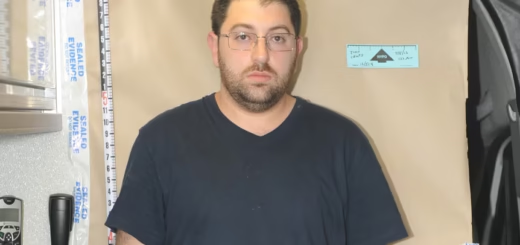
“The Bluegrass Mystery”: Dateline NBC Reports on Ella Jackson Homicide July 10 2026

Dateline NBC examines the disappearance and killing of Kentucky mother Ella Jackson in “The Bluegrass Mystery,” airing Friday, July 10, 2026, at 10:00 p.m. ET/9:00 p.m. CT. The two-hour episode follows correspondent Blayne Alexander as she traces a case that began with a missing-person report and developed into a homicide investigation built on blood evidence, conflicting statements and the discovery of skeletal remains.
The broadcast includes the first television interview with Richmond Police Department lead investigator Jason Friend. Richmond Police Chief Rodney Richardson also discusses the work that led detectives from Ella’s home in Richmond to rural Pulaski County, where her remains were found near property connected to her husband, Glenn Jackson. The episode explores how investigators solved the central question of responsibility without recovering enough evidence to establish a precise cause of death.
- Who Is Glenn Jackson & Where Is He Now? 2026 Update & Profile
- Who Was Ella Jackson & What Happened to Her? 2026 Update & Profile
Contents
- Ella Jackson’s Life and Family
- The Disappearance in October 2019
- The Three Men Investigators Examined
- Evidence of Trouble Inside the Marriage
- The Blood Evidence in Glenn Jackson’s Vehicle
- The Discovery of Ella Jackson’s Remains
- The Case Against Glenn Jackson
- Glenn Jackson’s Alford Plea
- The Sentencing and 14-Year Prison Term
- The Family’s Statements in Court
- The Effect on Ella Jackson’s Children
- Civil Proceedings and Guardianship
- Why the Case Did Not Reach a Murder Trial
- Questions That Remain Unanswered
- What “The Bluegrass Mystery” Reveals
- The Outcome of the Ella Jackson Case
- More “The Bluegrass Mystery”
- More Feature Articles
Ella Jackson’s Life and Family
Ella Diebolt Jackson was a 47-year-old Ukrainian-born mother of two who lived in Richmond, Kentucky. Family members described her as a devoted parent whose children shaped her plans and decisions. Her oldest son, Phillip Hans, remained in regular contact with her, while her youngest son lived with Ella and Glenn Jackson at the couple’s home on Westwood Drive.
Ella had maintained a relationship with her former husband, Jason Hans, after their marriage ended. Hans later said they remained friends and continued to communicate about their family. He became an important figure after Ella’s death, supporting the investigation and caring for Ella and Glenn’s young son.
Accounts from relatives portrayed Ella as warm, graceful and closely connected to members of her family in the United States, Ukraine and Russia. Those relationships became central to the search for her because her absence stood in sharp contrast with her normal pattern of communication.
The Disappearance in October 2019
Ella was reported missing on October 22, 2019, after Phillip became concerned that he had not heard from her. He told police that he spoke with his mother often and that a break in contact was unusual. His concern prompted family members and officers to examine the circumstances inside Ella’s home and the accounts offered by the people closest to her.
Glenn Jackson told police that Ella might have abandoned their son. He also claimed that she had left before and returned after periods away. Detectives found no clear evidence supporting the idea that Ella had chosen to leave her family.
Several personal items remained behind. Police found Ella’s cellphone, wallet and vehicle at the home. Her five-year-old son was also there. Those facts suggested she had not prepared for a trip or a permanent departure.
A parent leaving by choice would be expected to take basic possessions, arrange transportation or communicate with family. Ella’s unexplained absence, combined with the items left at the house, caused investigators to treat the case as a possible act of violence.
The Three Men Investigators Examined
The early investigation focused on three men with close relationships to Ella: Glenn Jackson, Phillip Hans and Jason Hans. Police had to determine whether one of them possessed information about her disappearance or had played a role in it.
Phillip’s conduct was tied to concern for his mother. His report brought the matter to police attention. Jason Hans also cooperated with investigators and described Ella’s fears about her marriage. The evidence did not establish a case against either man.
Glenn drew greater scrutiny because of the circumstances at the home and changes in his explanation. His claim that Ella had abandoned her child conflicted with the family’s description of her as a committed mother. His statements also failed to explain why her phone, wallet and vehicle remained behind.
Detectives examined the couple’s marriage, Glenn’s movements and the vehicles available to him. The case shifted from a broad inquiry involving several people to an investigation centered on Ella’s husband.
Evidence of Trouble Inside the Marriage
Police learned that Ella had taken steps to leave her marriage during the days before her disappearance. She met with a domestic violence advocate and consulted a divorce attorney. Prosecutors viewed those meetings as evidence that she feared for her safety and was considering separation.
Jason Hans said Ella had expressed fear over several years. In messages and phone calls, she described being afraid to leave a bedroom, being dragged through the house and fearing for herself and her child. These statements placed her disappearance within a history of reported conflict and alleged abuse.
Relatives believed Ella planned to take her young son and leave Glenn. Her disappearance occurred before she could carry out that plan. Prosecutors argued that the prospect of divorce, loss of control and a custody dispute supplied a motive for Glenn to kill her.
The domestic violence evidence did not reveal how Ella died, but it provided context for the events of October 2019. It also challenged Glenn’s suggestion that she had left without warning and abandoned her son.
The Blood Evidence in Glenn Jackson’s Vehicle
A major break came through the forensic examination of Glenn Jackson’s vehicle. Investigators used luminol, a chemical that produces light when it reacts with substances associated with blood, to inspect the trunk.
The testing revealed a stain reported to be about two feet in diameter. Authorities described the amount of blood evidence as significant. A knife recovered from the trunk also reacted to luminol.
The presence of blood in the trunk supported the theory that Ella had been killed and transported in the vehicle. Prosecutors argued that the evidence connected Glenn to both the death and an attempt to conceal what had happened.
The testing became central because Ella’s body had not been found at the time. Without remains, detectives lacked a medical cause of death and a crime scene that could provide a complete account. The trunk evidence gave the investigation a physical foundation.
In April 2020, about six months after Ella disappeared, Glenn Jackson was charged with murder, abuse of a corpse and tampering with physical evidence. The charges reflected the prosecution’s belief that he had killed Ella, moved her body and taken steps to hide evidence.
The Discovery of Ella Jackson’s Remains
One week after Glenn’s arrest, investigators found Ella’s partial skeletal remains in a remote, wooded area of Pulaski County. The site was near property owned by Glenn, including land associated with a lake house.
Women’s clothing was found scattered near the remains. The condition of the body indicated that Ella had been exposed to the elements for months, limiting the information available to the medical examiner.
The discovery confirmed that Ella had not left Richmond to begin a new life. It also connected the disposal site to land associated with Glenn, strengthening the prosecution’s circumstantial case.
A medical examiner ruled Ella’s death a homicide but could not determine the means of death. Her remains showed a significant skull fracture, but the state of decomposition prevented a conclusion about whether the fracture caused her death or formed part of a broader assault.
The inability to establish a precise cause of death created a problem for prosecutors. They could show that Ella had been killed, that her blood was found in Glenn’s vehicle and that her remains were left near his property. They could not explain the full sequence of the killing through medical evidence.
The Case Against Glenn Jackson
The prosecution’s case rested on connected pieces of circumstantial evidence. Ella disappeared while preparing to leave her marriage. Her phone, wallet, vehicle and child remained at home. Glenn supplied conflicting explanations about where she had gone.
Investigators found a large bloodstain and a knife in Glenn’s trunk. Ella’s remains were recovered near property associated with him. Her skull had a major fracture, and her death was classified as homicide.
Prosecutors also considered evidence that Glenn had spoken about the killing to a friend. Jason Hans said there was evidence that Glenn confessed to one of his closest friends in December 2019, though Glenn denied responsibility.
No single piece of evidence provided a full account of the crime. Taken together, the evidence allowed prosecutors to argue that Glenn killed Ella during a period of marital crisis, transported her body and left it in Pulaski County.
The prosecution faced risks at trial because no witness could describe the killing and the medical examiner could not establish how Ella died. Glenn continued to maintain his innocence. The state still believed the evidence could support a conviction, but a jury trial would have required jurors to reach a verdict from a case without a known murder weapon, a complete body or a confession accepted by the defendant.
Glenn Jackson’s Alford Plea
Glenn avoided a murder trial by entering an Alford plea to first-degree manslaughter, abuse of a corpse and tampering with physical evidence. An Alford plea permits a defendant to maintain innocence while acknowledging that prosecutors possess evidence that could produce a guilty verdict.
The plea reduced the original murder charge to manslaughter. Glenn did not admit that he killed Ella and did not provide her family with an explanation of what happened inside the home or how she received the skull fracture.
The agreement resolved the criminal case without a jury trial. It also protected prosecutors from the risk of an acquittal while securing convictions tied to Ella’s death, the handling of her remains and the destruction or concealment of evidence.
For Ella’s family, the plea carried mixed consequences. Glenn faced imprisonment, but the agreement left major questions unanswered. The family did not receive a confession, a detailed account of the crime or a murder conviction.
The Sentencing and 14-Year Prison Term
In April 2026, a Madison County Circuit Court judge sentenced Glenn Jackson to 14 years in prison, the term recommended under the plea agreement. The sentence covered manslaughter, abuse of a corpse and tampering with evidence.
Glenn received credit for time served, including a period on home incarceration after his 2020 arrest. Reports indicated that the credit could make him eligible for release in less than eight years.
The use of home incarceration drew criticism from Ella’s family. Jason Hans said Glenn could complete a large share of his sentence after spending years at a residence connected to his victim. He argued that the arrangement placed Glenn’s comfort and liberty above the value of Ella’s life.
Assistant prosecutor Jennifer Smith acknowledged the limits of the result during sentencing. She told the court that the outcome did not represent complete justice for Ella. The state had secured accountability, but the sentence and reduced charge did not match the harm described by her family.
The Family’s Statements in Court
Ella’s relatives in Ukraine and Russia participated in the sentencing through virtual statements. Her cousin Victoria described Ella as a person whose presence felt warm and full of life. The family spoke about the years lost after her death and the pain caused by the absence of answers.
Ella and Glenn’s son, who was 12 at the time of sentencing, submitted a recorded statement. He said he had attended kindergarten for only two months when his mother was killed. He described losing her presence throughout his childhood, teenage years and future.
The child said Glenn had told him that Ella left the family to return to Ukraine. After learning that his mother had been killed, he viewed that account as an act of cruelty. He stated that Glenn knew what he had done while allowing his son to believe that Ella had abandoned him.
Jason Hans also addressed the court. He described raising the child after Glenn’s arrest and telling him stories about Ella at bedtime. Over time, he struggled to find new memories to share.
Hans told the court that a necklace owned by Ella had become one of the child’s few physical connections to his mother. The boy kept it in a decorative box beside a photograph of Ella wearing it and sometimes fell asleep holding it.
The Effect on Ella Jackson’s Children
Ella’s death left both sons without their mother and placed her youngest child at the centre of a legal and family crisis. He was five when she disappeared and had limited ability to understand why she had vanished.
Jason Hans took responsibility for raising the boy after Glenn’s arrest. The arrangement kept the child with a person who had known Ella for years and could preserve memories of her life.
The plea agreement meant the child would not have to testify during a murder trial or face Glenn in court as a witness. Prosecutors viewed that protection as one benefit of resolving the case through a plea.
The boy’s statement showed that avoiding trial did not remove the emotional damage. He had spent years believing a false account about his mother’s disappearance and entered adolescence with knowledge that the man he once regarded as his father had been convicted in connection with her death.
Civil Proceedings and Guardianship
The conclusion of the criminal case allowed other legal matters to move forward. Jason Hans had filed a wrongful death lawsuit connected to Ella’s killing. The plea removed one barrier to pursuing that claim.
A wrongful death case uses a different legal standard from a criminal prosecution. The civil action could examine Glenn’s responsibility for Ella’s death and seek financial damages for the losses suffered by her family.
Hans also sought legal guardianship of Ella and Glenn’s son. Reports stated that the plea cleared the way for that process as the child approached his teenage years.
These proceedings form part of the case’s aftermath rather than the criminal sentence. They concern the child’s security, Ella’s estate and the family’s effort to obtain accountability through the civil courts.
Why the Case Did Not Reach a Murder Trial
Glenn was scheduled to stand trial on the murder charge before accepting the plea agreement. A trial would have required prosecutors to prove beyond a reasonable doubt that he killed Ella under circumstances meeting Kentucky’s murder statute.
The physical evidence was strong but incomplete. Ella’s blood was found in Glenn’s vehicle, and her remains were recovered near his property. The medical examiner could not identify the precise cause of death, and no public account established that investigators had recovered a weapon tied through forensic evidence to the fatal injury.
The passage of six years also created practical concerns. Witness memories can weaken, legal disputes can delay proceedings and evidentiary questions can shape what jurors are permitted to hear.
The Alford plea gave the state guaranteed convictions and a prison sentence. It spared Ella’s family and her son from a trial that could have ended without a conviction. The cost was a reduced charge and a sentence that family members considered inadequate.
Questions That Remain Unanswered
The criminal case established Glenn Jackson’s legal responsibility through his pleas to manslaughter, abuse of a corpse and evidence tampering. It did not establish an agreed narrative of the killing.
The location of Ella’s death has not been confirmed in public accounts. Investigators found evidence suggesting that her body had been placed in Glenn’s trunk, but the record does not explain whether she died at the Westwood Drive home, inside a vehicle or at another location.
The manner in which Ella received the skull fracture also remains uncertain. The medical examiner could not determine whether she was struck with an object, injured with the recovered knife, attacked through another means or subjected to more than one form of violence.
Glenn’s refusal to admit responsibility means he has not explained why Ella was killed, how her body was moved or what happened to evidence that could have revealed the cause of death. Those unanswered questions remain with her sons, relatives and investigators.
What “The Bluegrass Mystery” Reveals
“The Bluegrass Mystery” presents the case as an example of how a missing-person investigation can become a homicide prosecution through forensic evidence and close examination of personal relationships. Blayne Alexander follows the progression from Phillip Hans’ concern to the search of Glenn’s vehicle, the discovery of Ella’s remains and the plea agreement.
Lead investigator Jason Friend’s interview offers insight into the decisions made by Richmond police as Glenn’s statements came under scrutiny. Chief Rodney Richardson provides further context about the department’s efforts to build a case without a known cause of death.
The episode also centres Ella as a mother who was preparing to leave a troubled marriage. Her meetings with a domestic violence advocate and divorce attorney give the case a broader significance concerning the risks faced by people attempting to leave abusive relationships.
The outcome brought a conviction and a prison sentence but did not deliver the resolution Ella’s family sought. Glenn Jackson maintained his innocence, the murder charge was reduced and the details of Ella’s final moments remain unknown.
The Outcome of the Ella Jackson Case
The investigation concluded that Ella Jackson was the victim of homicide. Glenn Jackson was arrested in April 2020 after blood evidence was found in his vehicle, and Ella’s remains were recovered near his property one week after the arrest.
Glenn entered an Alford plea to first-degree manslaughter, abuse of a corpse and tampering with physical evidence. He was sentenced to 14 years in prison in April 2026 and received credit for time spent under home incarceration.
The plea ended the possibility of a murder trial and ensured Glenn would serve a prison term. It also allowed civil litigation and guardianship proceedings involving Ella’s youngest son to continue.
For Ella’s family, the legal outcome represents accountability without full justice. They secured a conviction connected to her death, but they received no confession and no complete explanation of how she was killed.
Dateline NBC’s “The Bluegrass Mystery” airs Friday, July 10, 2026, at 10:00 p.m. ET/9:00 p.m. CT. The two-hour report documents how a missing Kentucky mother’s case exposed evidence of domestic conflict, forensic traces inside a vehicle and a body concealed in rural woodland, leading to a manslaughter conviction more than six years after Ella Jackson disappeared.
More “The Bluegrass Mystery”
- “The Bluegrass Mystery”: Dateline NBC Reports on Ella Jackson Homicide July 10 2026
- Who Is Glenn Jackson & Where Is He Now? 2026 Update & Profile
- Who Was Ella Jackson & What Happened to Her? 2026 Update & Profile
More Feature Articles
- “The Bluegrass Mystery”: Dateline NBC Reports on Ella Jackson Homicide July 10 2026
- “House of Cards”: 20/20 Reports on Angel Goyena & Vonda Goyena Homicides July 10 2026
- “Chameleon”: Dateline NBC Examines the Two Missing Wives of Convicted Killer John Smith July 11 2026
- “My Mother’s Murder Trials”: 48 Hours Investigates the Dana Chandler Case on July 11 2026
- 60 Minutes Reports on “The Vatican’s Orphans”, “Sealand” & “Christopher Nolan” on July 12 2026